
Does Invisalign Work? Complete Guide to Effectiveness, Results, and What to Expect
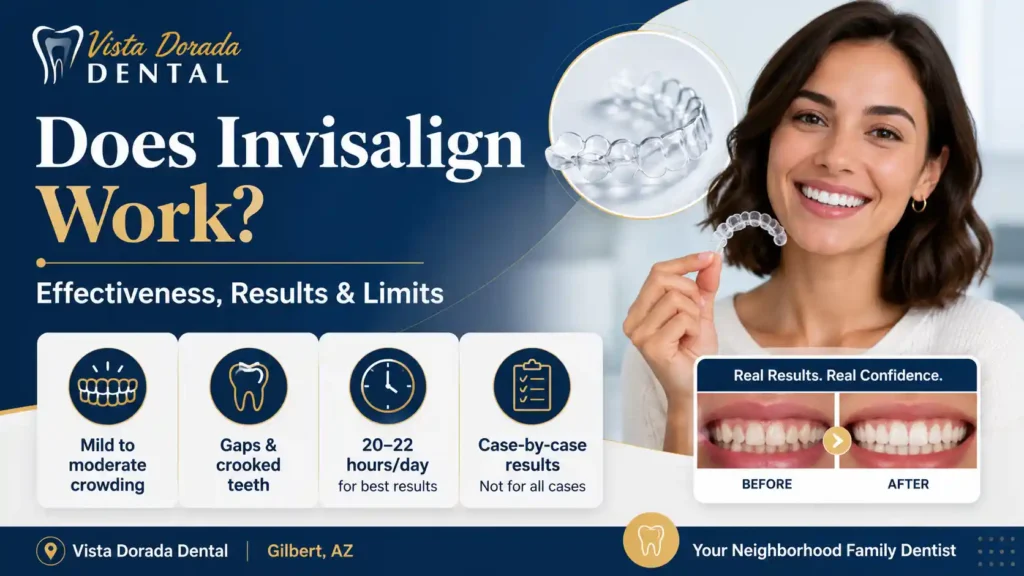
Yes, Invisalign does work for many people. It can help correct mild to moderate crowding, gaps, crooked teeth, and certain overbite, underbite, crossbite, and open-bite problems. The custom clear aligners apply controlled pressure to gradually move teeth into better positions. How effective Invisalign is depends on the complexity of the dental problem, the accuracy of the treatment plan, and how consistently the aligners are worn. Patients are typically instructed to wear them for 20 to 22 hours each day. Removing them too often, changing trays incorrectly, or missing appointments can delay progress and affect the final result. At Vista Dorada Dental in Gilbert, AZ, patients can receive a personalized evaluation to determine whether clear aligners are suitable for their teeth and bite. There is no single Invisalign success rate that applies to everyone, so this guide explains how Invisalign works, what it can correct, what affects its effectiveness, and how to determine whether it may work for you. Does Invisalign Work? Yes, Invisalign does work when it is used for a suitable orthodontic problem and worn as directed. Clear aligners can produce meaningful improvements in tooth alignment. However, their effectiveness is not the same for every movement or every patient. Research shows that clear aligner treatment can be effective for mild to moderate crowding. It also shows that some movements, including significant rotation, intrusion, and extrusion, can be less predictable. (PubMed) This does not mean Invisalign cannot perform difficult movements. Attachments, elastics, refinements, and other techniques can improve control. However, complex cases may require a longer plan or a different orthodontic approach. How Effective Is Invisalign? Invisalign can be highly effective for the right patient, but effectiveness must be judged according to the condition being treated. Straightening mildly crooked teeth is different from correcting a severe bite problem. A person with small gaps may have a simpler and more predictable plan than someone who needs several teeth rotated or moved vertically. In general, Invisalign tends to be more predictable for: Mild to moderate crowding Small or moderate spaces between teeth Mildly crooked or tilted teeth Relapse after previous orthodontic treatment Selected overbite, underbite, crossbite, and open-bite cases It may be less predictable when treatment requires: Large tooth rotations Significant vertical movement Major changes in tooth root position Severe crowding Complex bite correction Major jaw-position changes A systematic review found that clear aligners can resolve mild to moderate crowding, but the predictability of individual movements varies. Tipping movements were generally more predictable than rotation, intrusion, and extrusion. What Is Invisalign? Understanding Clear Aligner Treatment Invisalign is a clear aligner system used to straighten teeth without metal braces. Instead of wires and brackets, you wear a set of see-through plastic trays that fit over your teeth like a thin mouthguard. Each tray is custom made for your mouth. The biggest difference from traditional braces is how it looks and feels. Braces are fixed to your teeth and stay on the whole time. Invisalign aligners come out. Most people around you will not even notice you are wearing them. Invisalign came out in the late 1990s from a company now called Align Technology. Use computer planning to map tooth movement, then build a series of trays to do it step by step. Since then, more than 20 million people have used it. How Does Invisalign Work? Invisalign moves teeth through a biological process called bone remodeling. Your teeth are supported by bone and surrounding tissues. When an aligner applies controlled pressure, the bone and tissues around a tooth gradually adapt. This allows the tooth to move in the planned direction. Treatment usually follows several stages. Dental Examination and Consultation Your dentist first examines your teeth, gums, jaws, and bite. They may also take X-rays, photographs, or other diagnostic records. This examination helps determine whether Invisalign can safely and predictably address your concern. It may also reveal cavities, gum problems, or other conditions that should be treated before orthodontic care begins. Digital Scan and Treatment Plan A digital scanner creates a detailed model of your teeth. Your dentist uses this model to plan the direction and approximate amount of movement needed. The digital preview can help you understand the proposed outcome. However, it is a treatment simulation rather than a guaranteed picture of the final result. Teeth do not always move exactly as predicted. Custom Aligners A series of aligners is made according to the treatment plan. Each tray is shaped to apply pressure to selected teeth. You normally wear each set for the period prescribed by your dentist before moving to the next set. The schedule may vary based on your treatment plan and how well your teeth are tracking. Progress Appointments You will return for regular appointments so your dentist can check your progress. They will make sure the trays still fit and that the teeth are moving in the intended direction. When a tooth does not follow the plan, your provider may adjust the treatment or order additional aligners. Retainers After Treatment After the active aligner phase ends, you will need a retainer. Retainers help hold the teeth in their new positions while the surrounding bone and tissues stabilize. Long-term retainer wear is important because teeth can continue to shift throughout life. (American Association of Orthodontists) Does Invisalign Work? Yes, Invisalign does work when it is used for a suitable orthodontic problem and worn as directed. Clear aligners can produce meaningful improvements in tooth alignment. However, their effectiveness is not the same for every movement or every patient. Research shows that clear aligner treatment can be effective for mild to moderate crowding. It also shows that some movements, including significant rotation, intrusion, and extrusion, can be less predictable. This does not mean Invisalign cannot perform difficult movements. Attachments, elastics, refinements, and other techniques can improve control. However, complex cases may require a longer plan or a different orthodontic approach. How Effective Is Invisalign? Invisalign can be highly effective for the right patient, but effectiveness must be judged according to the