
Is Invisalign Better Than Braces? A Complete Comparison
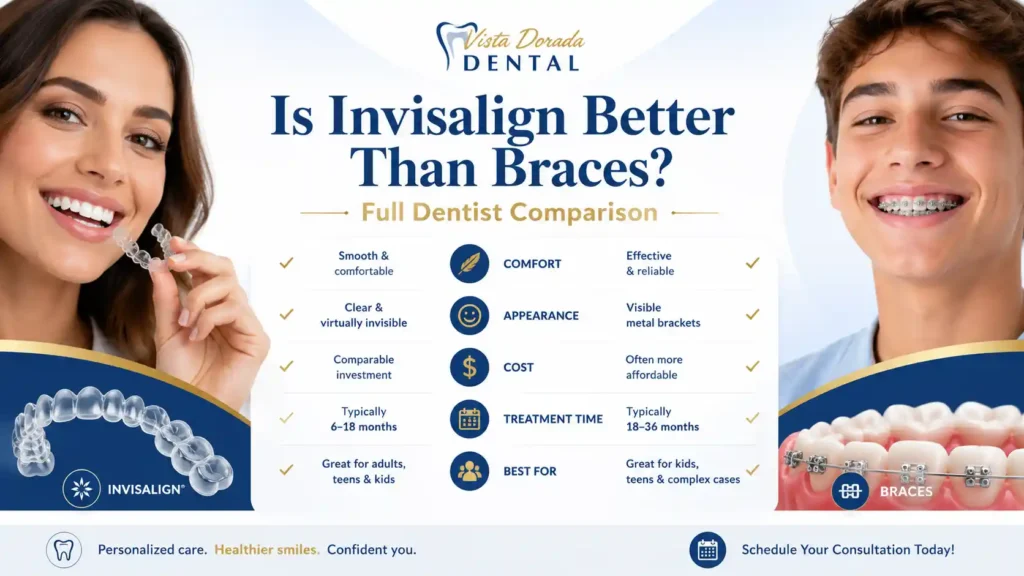
Invisalign is often better for people who want discreet, removable treatment and easier oral hygiene. Braces may be the better choice for severe crowding, complex bite problems, or patients who may not wear aligners consistently. Both treatments can straighten teeth and correct many bite issues. Invisalign usually offers fewer food restrictions and less irritation from brackets or wires. Braces work continuously and may provide more precise control over difficult tooth movements. Neither option is always faster, cheaper, or more effective for every patient. At Vista Dorada Dental in Gilbert, AZ, patients can receive a personalized evaluation to determine which treatment best fits their teeth, bite, age, and daily routine. This guide compares results, treatment time, comfort, cost, hygiene, and suitability for adults, teens, and children so you can make a more informed choice for your smile. Is Invisalign Better Than Braces? The Quick Answer Invisalign may be better than braces if you have a suitable orthodontic problem and can wear your aligners as directed. Braces may be better when your case requires more complex or highly controlled tooth movement. Invisalign offers several lifestyle advantages. The aligners are less noticeable, removable for meals, and easier to work around when brushing and flossing. Braces have their own advantages. They remain attached to the teeth, so you do not need to remember to wear them. They can also provide precise control during complicated bite corrections. Research suggests that clear aligners and fixed braces can both treat many simple orthodontic cases successfully. However, the quality of available evidence varies. Some movements and complex cases may still be treated more predictably with fixed braces. (PubMed) Therefore, Invisalign is not automatically better just because it is newer or less visible. The best treatment is the one that can safely correct your specific bite while matching your ability to follow the plan. Invisalign vs. Braces: Key Differences at a Glance Factor Invisalign Traditional Braces Appearance Clear and less noticeable Metal brackets and wires are visible Removability Removed for eating and cleaning Fixed to the teeth Effectiveness Suitable for many mild, moderate, and selected complex cases Suitable for mild through highly complex cases Responsibility Requires consistent daily wear Works without removal Food restrictions Few restrictions after trays are removed Hard, sticky, and chewy foods may need to be avoided Oral hygiene Teeth are easier to brush and floss Cleaning around brackets takes more effort Comfort Smooth trays but pressure and attachment irritation may occur Pressure, brackets, and wires may cause soreness Repairs Aligners can be lost, damaged, or stop fitting Brackets and wires can loosen or break Visibility Attachments and elastics may still be noticeable Ceramic braces may be less visible than metal braces Retainers Required after treatment Required after treatment The table gives a general comparison. Your orthodontist may recommend additional attachments, elastics, expanders, or other appliances with either treatment. Is Invisalign Better Than Braces for Different Age Groups? Age alone does not decide the best appliance. Tooth development, jaw growth, treatment complexity, maturity, and daily habits all matter. Is Invisalign Better Than Braces for Adults? Invisalign can be a strong option for adults who want discreet treatment and can manage the daily routine. Adults often appreciate removing aligners for meals, photographs, presentations, and important events. Normal brushing and flossing access can also be helpful for patients with extensive dental work or gum concerns. However, adults may have crowns, bridges, implants, missing teeth, bone loss, or previous gum disease. These factors require careful planning. Healthy teeth can be moved at different ages, but adult treatment must reflect the patient’s complete dental history. Braces may be more suitable when the case requires extensive bite correction or when wearing aligners for most of the day would be unrealistic. Is Invisalign Better Than Braces for Teens? Invisalign may suit responsible teens who care about appearance, play instruments, or want fewer food restrictions. The main concern is compliance. Aligners need to be worn consistently and returned to the mouth after meals, snacks, and sports. A teen who regularly loses retainers, forgets instructions, or removes the trays for long periods may achieve a more reliable result with braces. Braces can be easier for parents to monitor because the appliance remains attached. However, the teen must still clean carefully, avoid damaging foods, attend appointments, and wear any prescribed elastics. Is Invisalign Better Than Braces for Kids? Invisalign is not automatically better for younger children. Some children can use clear aligners, but their teeth and jaws are still developing. Removable trays also require maturity. A child must keep track of the aligners, wear them for the required time, and maintain proper cleaning. Braces or other fixed appliances may be preferred when growth guidance, expansion, severe crowding, or predictable compliance is important. Who Is a Good Candidate for Invisalign? A complete examination is needed before someone can be considered a suitable candidate. Patients With Mild to Moderate Alignment Problems Invisalign often works well for mild or moderate crowding, spacing, and selected bite problems. Some more complex cases can also be treated with aligners, especially when attachments, elastics, and other techniques are used. Suitability should be based on the required movements rather than a general label such as “mild” or “severe.” Patients Who Can Follow the Aligner Wearing Schedule Good candidates can wear the trays for the prescribed hours, remove them before meals, clean their teeth, and change aligners correctly. They must also be comfortable keeping track of the trays throughout work, school, travel, and social events. Cases That May Not Be Suitable for Invisalign Braces may be recommended when the treatment requires highly complex rotations, significant root movement, impacted tooth guidance, severe bite correction, or another appliance that works better with fixed treatment. Active cavities, untreated gum disease, and poor oral hygiene may also need attention before either form of orthodontic treatment begins. Who Is a Better Candidate for Braces? Braces are not an outdated fallback. They remain a highly versatile orthodontic treatment. Patients With Severe or Complex Orthodontic Problems Fixed braces may provide